Comparisons
IPTV vs classic streaming: what are the differences?
IPTV vs streaming: how IPTV, on-demand platforms like Netflix and terrestrial TV differ in delivery, live content, catalog and Internet requirements.
The terms “IPTV”, “streaming” and “Internet television” are often used interchangeably, leading to confusion. This comparison details the real differences between three ways of watching video content today: IPTV, on-demand streaming platforms and classic terrestrial television.
What defines streaming?
Streaming designates a playback method: video data is transmitted and played as it is received, without requiring the complete download of the file before starting playback, as noted in the Wikipedia definition. It's a transmission technique, not a type of content — it applies to both on-demand and live video.
IPTV uses this same streaming technique. The difference therefore does not lie in the playback technology, but in the way the content is organized and presented to the user.
IPTV vs on-demand streaming (Netflix): what changes?
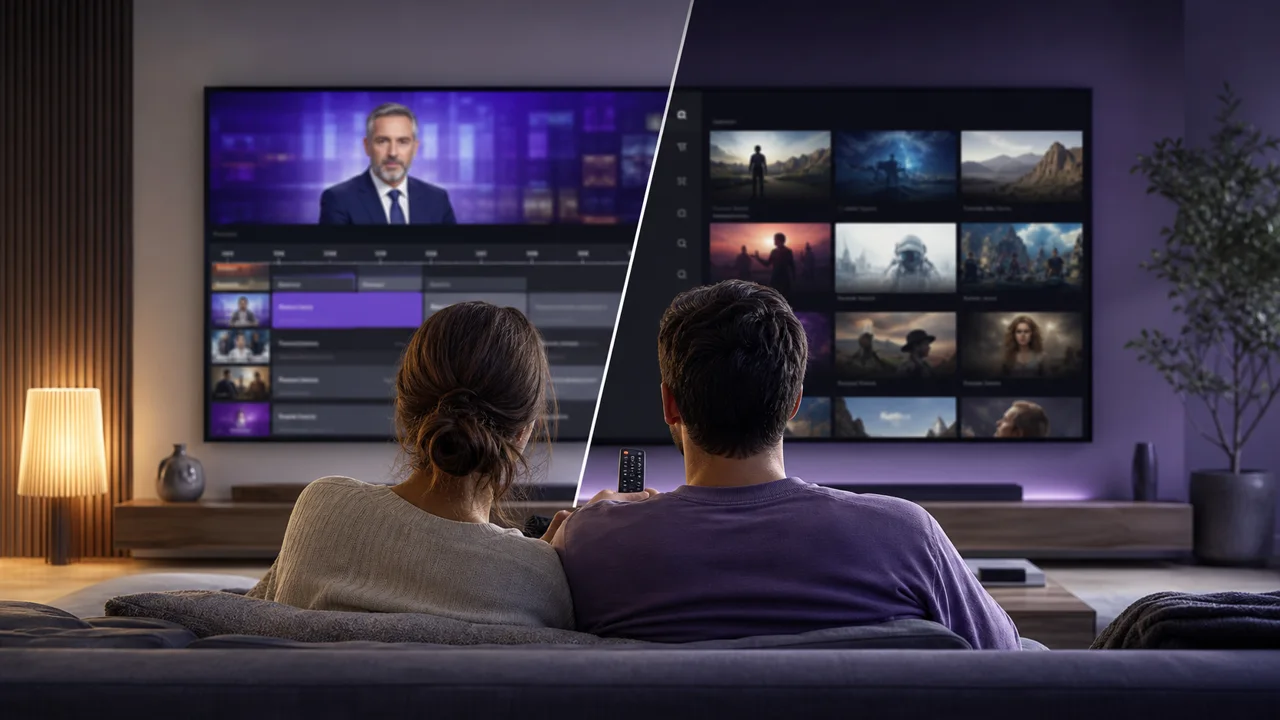
IPTV organises content as live, numbered channels with a program guide, while on-demand streaming works as a catalog of films and series you play whenever you want. The table sums up the practical differences:
| Criterion | IPTV | On-demand streaming |
|---|---|---|
| Content organization | Numbered channels, television style | Catalog of films/series, by genre |
| Live / zapping | Yes, with program schedule (EPG) | Generally absent or marginal |
| Login | M3U URL or Xtream Codes identifiers | Classic user account (email/password) |
| Application | IPTV player (VLC, TiviMate, IPTV Smarters Pro…) | Platform proprietary application |
| Scheduled interruption | Rare (live channels broadcast continuously) | None (playback on demand, pause possible) |
An on-demand streaming platform lets you choose a title from a catalog and play it whenever you want, with pause and restart. IPTV, on the other hand, reproduces the logic of a television channel: you “zap” between channels which broadcast a program continuously according to a timetable, which can be consulted via a program guide (EPG).
IPTV vs TNT/operator box: what is the role of the Internet?
Digital terrestrial television (DTT) broadcasts channels via a network of terrestrial transmitters, picked up by an antenna, so no Internet connection is necessary. IPTV, on the other hand, depends entirely on functional Internet access: without a stable connection, no channel can be played.
Many Internet boxes provided by telecom operators also broadcast their own IPTV channels, via a dedicated or shared network with the home's Internet connection - a concrete example that IPTV technology, as defined on Wikipedia, is already widely used without the user always being aware of it.
Why does this distinction matter in practice?
Understanding these differences helps you choose the right application and adjust your expectations:
- If you are looking for an experience close to classic television (zapping, live, programs), IPTV with an application like TiviMate or IPTV Smarters Pro is better suited to this use — see our comparison of IPTV applications.
- If you are looking to watch a specific title at a specific time, an on-demand platform is more suited to this use.
- Both can coexist on the same device without any special configuration.
How do you choose your service wisely?
Whether in IPTV or on-demand streaming, the quality of a service is judged by its reliability, its catalog and its support, not by the technology used. Our checklist for a reliable IPTV subscription details the points to check before subscribing.
In summary
IPTV and on-demand streaming share the same Internet transmission technique, but organize the content very differently: live television-style channels for one, on-demand catalog for the other. TNT remains independent of any Internet connection. To understand in more detail how IPTV works on a technical level, see our definition article.
Frequently asked questions
Is IPTV a type of streaming?
Yes in the broad sense: both transmit video via the Internet rather than via physical media. The difference is in the organization of content - live television-style channels for IPTV, on-demand catalog for streaming platforms such as Netflix.
Can you watch IPTV on the same device as a streaming platform?
Yes. Both work through separate applications installed on the same device (Smart TV, box, mobile), without conflict between them.
Does IPTV replace TNT?
It can complement or replace it depending on usage, but it depends entirely on your Internet connection, whereas DTT works via terrestrial antenna, independently of the Internet network.
Why does IPTV offer zapping when it goes through the Internet?
Because it deliberately reproduces the organization of a classic television offering – numbered channels, EPG, live channel change – rather than the catalog model of on-demand platforms.
Is more bandwidth required for IPTV than for Netflix?
Throughput requirements depend mainly on the resolution viewed (SD, HD, 4K), not on the type of service. A 4K IPTV stream requires a throughput comparable to a 4K stream on any streaming platform.